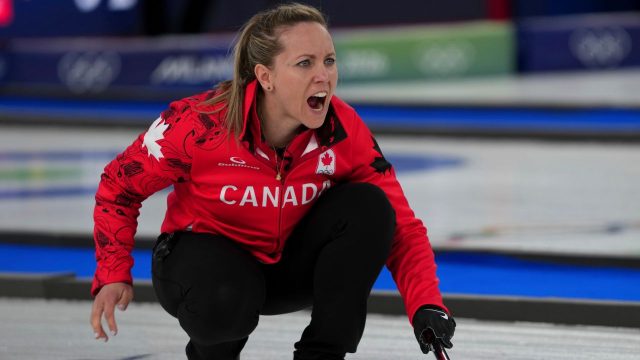
The gold medal was not meant to be for Canada’s Team Rachel Homan at the 2026 Olympics.
After starting the week 1-3 and winning five straight to run the table to get into the playoffs, the Canadian rink fell short in the semifinal match against Sweden’s Team Anna Hasselborg 6-3 in Milano Cortina, thus ending their chance for gold.
“We were just a little bit on the wrong side of the inch, (Sweden) played a phenomenal game,” Homan told CBC Olympics after the loss. “Kudos to them for the way they played, and yeah, we were just not quite as sharp.”
Even though Homan’s Ottawa-based rink will have a chance to earn an Olympic medal, this feels like a huge letdown.
Why? Based on what Homan and her teammates, Tracy Fleury, Emma Miskew, and Sarah Wilkes had done over the past two and a half years leading up to these Games, the bar was set at gold or bust.
A record of 191-27 before coming into the Olympics, back-to-back undefeated Scotties championships, followed up by back-to-back world championships and six Grand Slam of Curling titles.
But yet, this entire week, Homan’s team just never seemed to find their top form, and it finally caught up to them in the semifinals.
With the loss, Canada has now gone without gold in the women’s discipline since 2014, when Jennifer Jones won in Sochi.
-

-
Women’s Olympic curling standings, schedule, results
Team Rachel Homan will try to get Canada back on the Olympic podium for the first time since 2014 this month in Italy. Follow all the action with Sportsnet.

Homan wasn’t the weak link
Homan could not lose a game for the next four years; it’s not going to matter. The Olympics top everything in curling, and so, Canadian curling fans right before the 2030 games will still be questioning why Homan couldn’t get it done on the biggest stage.
While that’s fair considering the results, it’s important to note that Homan’s performances at these games, while not her best, weren’t the reason the team couldn’t get the job done.
Just like her teammates, she did struggle on some low-degree-of-difficulty shots you wouldn’t expect Homan to miss the entire week, like blank attempts where she instead hit and stuck to just take one point. But for the most part, there was only so much Homan could do with how each end shaped up before her stones.
Homan’s performance versus Korea is the only reason Canada was in the semifinal, and it looked like, against Sweden through five ends, Homan might be able to carry the team again with the game tied 2-2.
Especially her shot in the second end through a tight port to get one, when just trying to give up a steal of one instead of two was the call.
In the second half of the game, though, Sweden’s front end upped their game, while Canada’s didn’t, making the difficulty of Homan shots nearly impossible. She did the best she could, but in the end, no skip would’ve been able to win that game.
It could have been easy for Homan to get frustrated with her teammates afterwards, but instead, she stood by their side.
“You’re not going to win every game, we’re gonna come back and fight hard (Saturday).”
Hard to win without four of the eight rocks
The two Canadian players who struggled the most were Fleury and Miskew.
Give them credit: both tried to battle through the whole competition, but in the end, against Sweden in the semifinal, they were no match for Hasselborg’s third, Sara McManus, and second, Agnes Knochenhauer.
Based on how important Miskew and Fleury have been to this team’s success over their untouchable run, in each end of every game, you thought maybe this would be the one where it just clicks for them, but it never came. Instead, it got worse in the semis.
At this level of curling to win, rock placement has to be precise, and that was the biggest issue for Miskew. In the entire game against Sweden in the semifinal, Miskew had a bunch of hit and rolls where she would either roll way too much or just hit the rock dead nose, leaving the Swedes with the ability to make an even better shot on their next.
For Fleury, however, she just couldn’t make a shot to save her life, and it was all stemming from a lack of confidence she had in the ice to actually make the shot that was called all week.
In multiple games throughout the tournament, Homan would call one thing, and Fleury would ponder if there was an easier shot for her to play. This, tagged along with being off on weight for most of the week, made it feel like Fleury was attempting a “Bruce Mouat runback triple type shot” every time she stepped into the hack.
Tirinzoni deserves to be in the gold-medal match
It’s hard to believe, considering all that Switzerland’s Team Silvana Tirinzoni, Alina Paetz, Carole Howald and Selina Witschonke have accomplished in curling, but by beating the U.S. team led by skip Tabitha Peterson 7-4 in the other semifinal, they have guaranteed their first Olympic medal.
And it couldn’t come at a better time.
Tirinzoni revealed at the last Slam event in January, in an interview with reporter Devin Heroux, that this might be her last competitive season.
“Possible it’s my last Slam, very possible,” Tirinzoni said after winning the Players’ Championship for the third straight year.
With that probably in the back of Paetz, Howald and Witschonke’s minds while playing the Americans in the semifinal, who they lost to the day before, they came through with yet another great performance, especially Paetz.
Paetz, who has won four world championships with Tirinzoni, curled 99 per cent versus the Americans. With hammer, the Swiss were able to score three deuces thanks to the shots Paetz would make every end. Meanwhile, when the U.S. had hammer all, they could get was one point.
If this is, indeed, it for Tirinzoni, there’s no better way to finish than playing for an Olympic gold medal.
-
-
Men’s Olympic curling standings, schedule, results
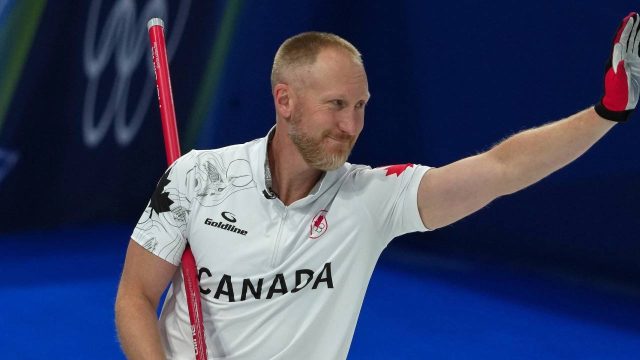
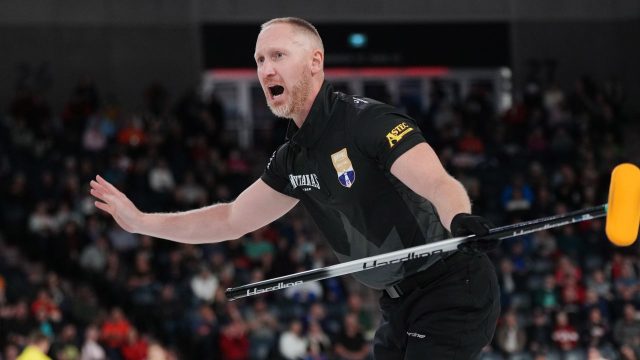
Team Brad Jacobs will aim to get Canada back on top of the Olympic podium for men’s curling for the first time since 2014 this month in Italy. Follow all the action with Sportsnet.

Swiss power their way to bronze
After an incredible week of curling, at least the Swiss team of Yannick Schwaller, Benoit Schwarz-van Berkel, Sven Michel and Pablo Lachat-Couchepin will stand on the podium wearing Olympic bronze.
Start to finish, they controlled their bronze-medal match against Norway, beating them 9-1.
No offence to Norway, as they had a great week finishing fourth overall — above what they were expected to do — but the talent gap between the two teams isn’t close, and it was on full display during this game.
To beat the Swiss, you need to outplay Schwarz-van Berkel, who throws fourth stones for the team, and Ramsfjell didn’t stand a chance. Schwarz-van Berkel set the tone in the second end when he made a three-ender appear out of nowhere by making a hit through a tight port on the outside of the sheet.
Again, in the eighth end, Ramsfjell thought he made a good shot drawing to the back four-foot buried, but Schwarz-van Berkel made a runback to score two more.
If not for one bad end versus Great Britain, this Swiss team very well could’ve been the Olympic champion.
The curling continues on Saturday at 8:05 a.m. ET/ 5:05 a.m. PT with the women’s bronze-medal match between Homan and Peterson, while the men’s gold-medal game will go at 1:05 p.m. ET/10:05 a.m. PT between Canada’s Brad Jacobs and Great Britain’s Bruce Mouat.